
 English
 Pусский
 Tiếng Việt
 中文
中文

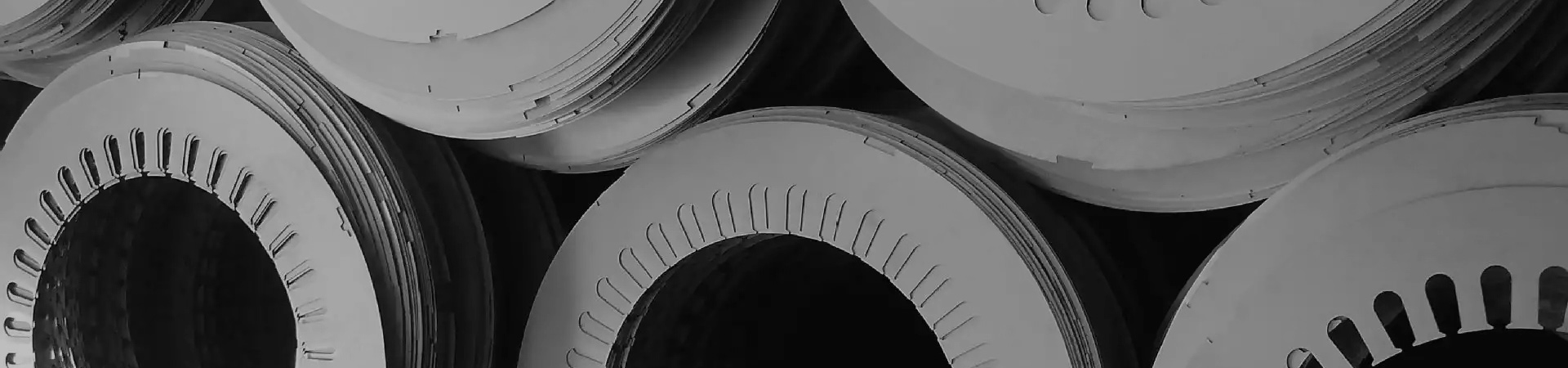
Motor laminations manufacturing
Motor Laminations Manufacturing Process Motor laminations are thin, stacked steel sheets used to form the core of electric motors and generators. They play a critical role in improving energy efficiency by reducing eddy current losses. The manufacturing process involves several precise steps to ensure high-quality laminations with tight tolerances and minimal waste. 1. Material Selection The process begins with selecting the appropriate electrical steel, typically silicon steel or other specialty alloys. The material is chosen for its magnetic properties, low core loss, and high permeability. The steel is supplied in large coils or sheets, which are then processed into thinner laminations. 2. Blanking or Stamping The steel sheets are fed into a high-speed stamping press or laser cutting machine to blank out the lamination shapes. Progressive dies or fine blanking techniques are used to achieve precise geometries, including slots, teeth, and mounting holes. The stamping process must minimize burrs and ensure dimensional accuracy to prevent performance issues in the final motor assembly. 3. Heat Treatment (Optional) Some laminations undergo stress-relief annealing to reduce internal stresses caused by stamping. This step improves magnetic properties and ensures consistent performance. The laminations are heated in a controlled atmosphere to prevent oxidation. 4. Insulation Coating To further reduce eddy currents, laminations are coated with an insulating layer. Common methods include: - Organic coatings (varnish or enamel): Applied via spraying or dipping. - Inorganic coatings (oxide or phosphate layers): Formed through chemical or thermal processes. The coating must be uniform and durable to withstand stacking and motor operation. 5. Stacking and Bonding Individual laminations are stacked and aligned to form the motor core. They can be held together using: - Interlocking tabs: Mechanically fastened during stamping. - Adhesives or welding: Provides rigidity but may slightly impact magnetic performance. - Press-fitting: Used for high-precision applications. 6. Quality Control Each batch undergoes rigorous testing, including: - Dimensional checks: Ensuring tolerances are met. - Coating integrity: Verifying insulation resistance. - Magnetic testing: Measuring core loss and permeability. 7. Final Assembly Finished lamination stacks are integrated into motor assemblies, where they interact with windings and other components to convert electrical energy into mechanical motion. Conclusion Motor lamination manufacturing requires precision engineering to optimize efficiency and performance. Advances in materials, stamping technology, and insulation techniques continue to enhance the quality and cost-effectiveness of these critical components. The process ensures that modern motors achieve higher energy efficiency, reduced noise, and longer service life.
제품
범주:
고정자와 회 전자
검색 결과가 없습니다!
뉴스
범주:
검색 결과가 없습니다!
케이스
범주:
검색 결과가 없습니다!
비디오
범주:
검색 결과가 없습니다!
다운로드
범주:
검색 결과가 없습니다!
모집
범주:
검색 결과가 없습니다!
추천 제품
검색 결과가 없습니다!
 모바일: +86 13738592999
 전화: +86(576) 89307999
 이메일: sales@zjxinzheng.com
 주소: 삼문 해안공업도시



 왓츠앱
왓츠앱 핸드폰
핸드폰