
 English
 Pусский
 Tiếng Việt
 中文
中文

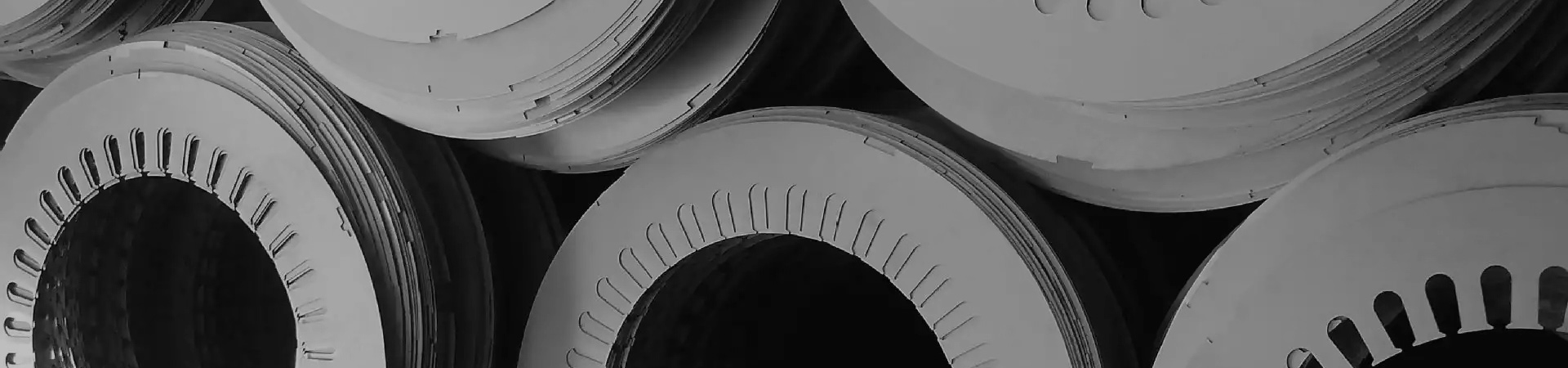
모터 라미네이션 스탬핑
Motor Lamination Stamping: Process and Key Considerations Motor lamination stamping is a critical manufacturing process used to produce the thin, stacked steel laminations that form the core of electric motors and generators. These laminations are essential for minimizing energy losses, reducing eddy currents, and improving the overall efficiency of the motor. The process involves precision stamping of electrical steel sheets into specific shapes, followed by stacking and bonding to create the motor core. 1. Material Selection The process begins with selecting the appropriate electrical steel, typically silicon steel or other specialized alloys. The material must have high magnetic permeability, low core loss, and good mechanical strength. The thickness of the steel sheets usually ranges from 0.1 mm to 0.65 mm, depending on the motor’s power and application requirements. 2. Stamping Process The steel sheets are fed into a high-speed stamping press equipped with precision dies. The dies are designed to cut and shape the laminations into the required geometry, which may include rotor slots, stator teeth, and other intricate features. The stamping process must maintain tight tolerances (often within ±0.05 mm) to ensure proper alignment and performance in the final motor assembly. Advanced stamping presses can achieve speeds of up to 1,000 strokes per minute, making the process highly efficient for mass production. Progressive dies are commonly used, allowing multiple operations (piercing, blanking, forming) to be completed in a single pass. 3. Quality Control Dimensional accuracy and edge quality are critical in motor lamination stamping. Burrs and deformations must be minimized to prevent short-circuiting between laminations and ensure smooth stacking. Laser cutting or fine blanking may be used for high-precision applications where traditional stamping is insufficient. 4. Stacking and Bonding After stamping, laminations are stacked and bonded using methods such as welding, interlocking, or adhesive bonding. Proper alignment is crucial to maintain magnetic performance and mechanical integrity. Some laminations may also undergo heat treatment or insulation coating to further reduce eddy current losses. 5. Applications and Benefits Motor laminations are used in various applications, including automotive motors, industrial machinery, and consumer electronics. The stamping process ensures high repeatability, cost-effectiveness, and scalability for large-scale production. Conclusion Motor lamination stamping is a highly specialized process that combines material science, precision engineering, and advanced manufacturing techniques. By optimizing die design, press parameters, and quality control, manufacturers can produce high-performance laminations that enhance motor efficiency and reliability. Continuous advancements in stamping technology further drive improvements in energy efficiency and production speed.
제품
범주:
검색 결과가 없습니다!
뉴스
범주:
-
[Industry News]산업용 모터의 모터 라미네이션 유지 관리를 위한 주요 팁
2025-10-07 16:19:17 -
[Company News]내구성 강화를 위한 모터 라미네이션 코팅
2025-10-08 08:55:16
케이스
범주:
검색 결과가 없습니다!
비디오
범주:
검색 결과가 없습니다!
다운로드
범주:
검색 결과가 없습니다!
모집
범주:
검색 결과가 없습니다!
추천 제품
검색 결과가 없습니다!
 모바일: +86 13738592999
 전화: +86(576) 89307999
 이메일: sales@zjxinzheng.com
 주소: 삼문 해안공업도시



 왓츠앱
왓츠앱 핸드폰
핸드폰